after a late diagnosis
An ADHD cleaning app for late-diagnosed adults
short answer
Getting an answer at 30, 40 or 50 does not delete the thirty years of evidence you collected before it, and most productivity tools run on exactly that evidence — counters, consecutive-day totals, badges that turn red. The only count in Nudge that a gap can touch is a streak built to forgive: it covers a missed day each week and waits while you take a break. No points, no leaderboard, no red badges. Finished tasks fill in a companion cat's island of rooms, and nothing ever takes a room back.
This page is about one specific thing: what a cleaning app should not do when the person using it has spent decades reading their own mess as a character flaw rather than a wiring difference.
Built from the can't-start problem, not a perfect-home ideal
I build Nudge alone, and I live with executive dysfunction. I designed it around one tiny action, changing capacity, and restarting without a missed-day penalty—the cleaning support I wanted to use myself.
Why scorekeeping lands differently here
- A late diagnosis arrives on top of decades of evidence, collected by you, that other people manage this and you do not. That evidence does not disappear the week you get an answer.
- Productivity tools are built on exactly that evidence. Counters, consecutive-day totals and red badges are all designed to make a gap feel like a cost.
- For someone who has spent thirty years reading gaps as character, a counter resetting is not motivating feedback. It is the old story, in an app you paid for.
- The reviews of apps in this category say it plainly. One, of a well-known self-care app: “I feel like I am treated as lesser than for not having a subscription.”
None of this makes those apps badly built. A counter is genuinely motivating for a lot of people, and the comparison hub says which ones do it well and where they beat Nudge on price. It is a question of whether that mechanism helps you or quietly confirms something you already believe.
What it offers instead
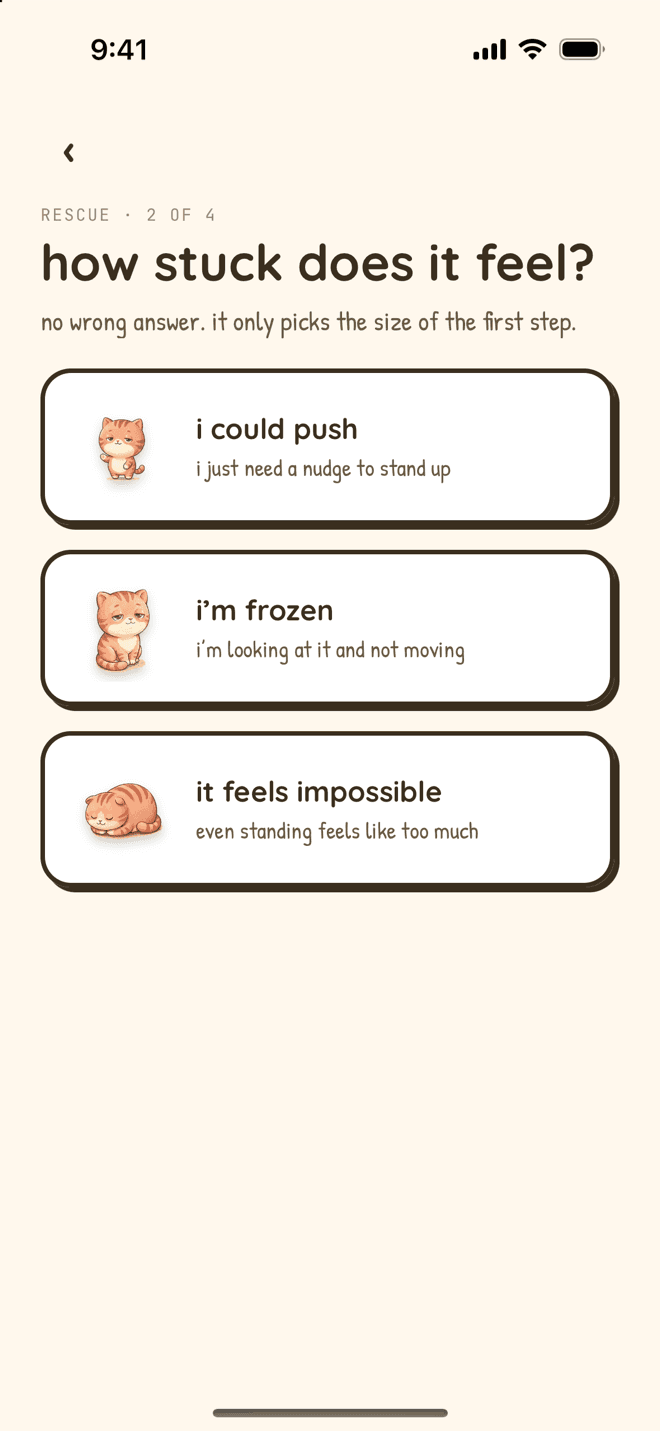
one question first
How stuck does it feel? No wrong answer. It only picks the size of the first step, which is then said out loud.
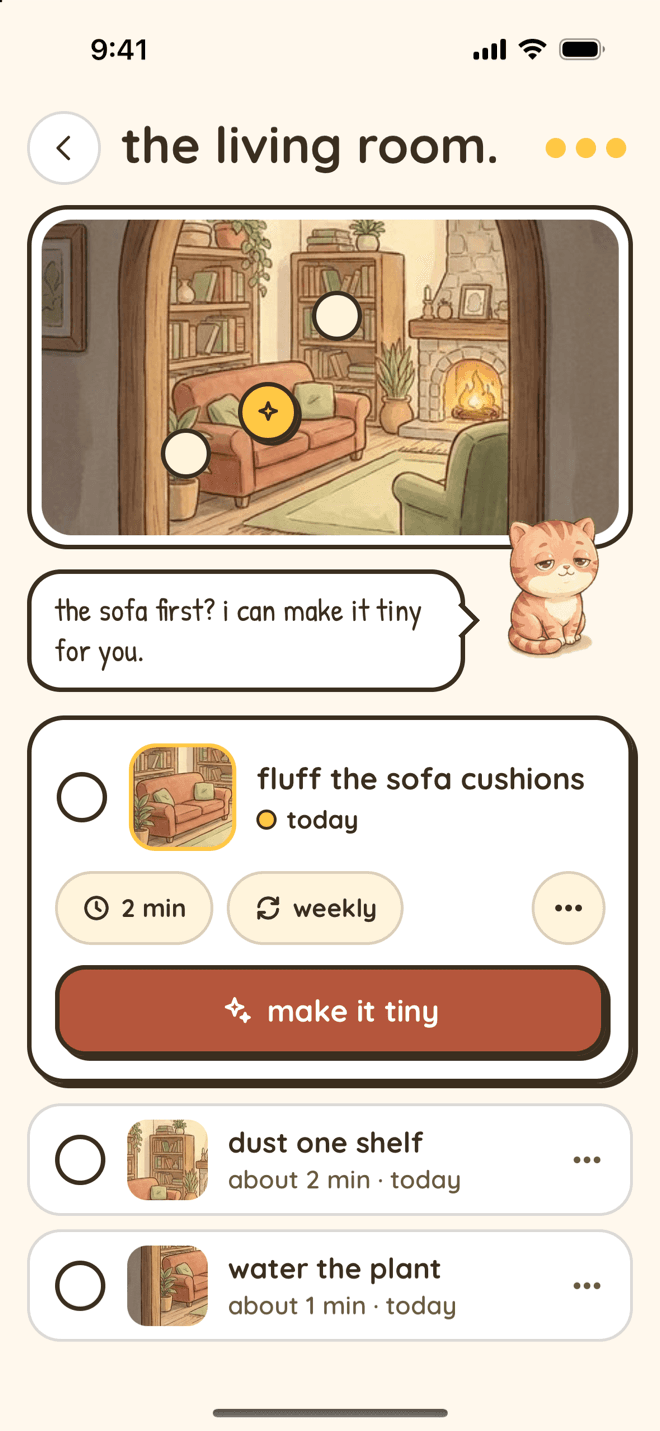
where to start, picked for you
A room's page puts one task first, and Mochi offers to make it tiny. Nothing on it counts against you.
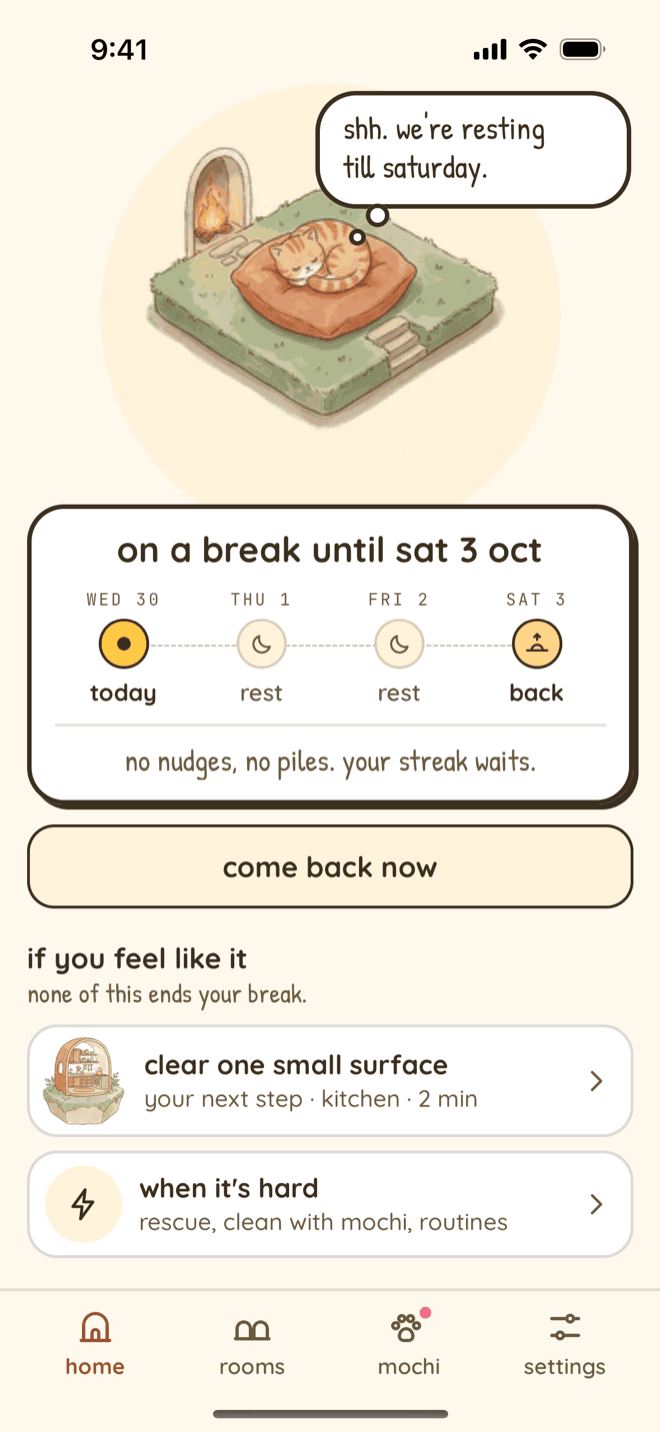
a gap you can plan
Take a break for days or weeks. No nudges arrive, nothing piles up, and your streak waits.
What is deliberately missing
No points. No leaderboard. No badge that changes colour because time passed. No summary of what you missed while you were away, and no list waiting to be cleared before you are allowed to begin.
Only one count can feel a gap, and it is built to forgive: a streak of the days you finished something, which covers a missed day each week and waits while you are on a break. After a longer gap it starts again from one, and nothing else you earned goes with it.
What is there instead: two questions — how you need to begin, and how long you have — and then one task. Start Rescue names a single physical action and reads it out when starting is the part that is stuck. Mochi's Place grows with finished tasks and only grows.
A gap costs you nothing you earned.
Nothing you earn is taken away
Nudge is a subscription for iPhone, billed only through the App Store. Weekly is $2.99 with no trial. Monthly is $6.99 and Annual is $49.99, and both include a 7-day free trial for eligible new subscribers.
Related
For the background rather than the tool, why ADHD brains struggle with cleaning covers the mechanism. If the apps you have tried buried the help under paragraphs, this one is about that. And the free browser version needs no signup and no install.
Other situations: ADHD cleaning app for students, ADHD cleaning app for shift workers, ADHD cleaning app for parents of toddlers.
Questions
Does Nudge track consecutive days?
Yes, gently, and it is worth knowing exactly how. The showing-up page keeps a forgiving streak: the days in a row you finished something. It covers one missed day each week, and days you spend on a break do not count against it. After a longer gap it starts again from one, quietly, with nothing red. There are no points and no leaderboard, and show-up days, levels, painted rooms and Mochi's outfits only ever add up.
What does it do when I come back after a bad month?
Much the same as on any other day: it asks how much you have got today, then gives you one task sized to that. It does notice the gap: Mochi may say a room has been lived-in since a certain day, and the streak starts again from one. If you took a break first, it welcomes you back and offers a fresh start. There is no summary of what you missed.
Is there anything that rewards finishing?
Yes, and it only goes one way. Finished tasks fill in Mochi's Place, a companion cat's island of rooms that grows as you use it, and showing up earns Mochi outfits. Nothing is ever removed from either.
I only just found out. Where do I even start?
With something smaller than feels reasonable. Start Rescue names one physical action — touch one cup, pick up the four things nearest the door — and reads it aloud so there is nothing to plan. During setup you can try one tiny task before you choose a plan.
Is this treatment, or a replacement for anything clinical?
No. Nudge organizes cleaning tasks. It is not treatment, it does not diagnose anything, and it is not a substitute for talking to a professional about a recent diagnosis.
Is Nudge free?
No. It is a subscription for iPhone. You can try one tiny task before you choose a plan. Weekly is $2.99 with no trial. Monthly is $6.99 and Annual is $49.99, and both include a 7-day free trial for eligible new subscribers.
How we checked, and when
Nudge's own plan details was read on 2026-09-15 from the company's own website or its current App Store listing. How Nudge counts show-up days, and what a gap does, were checked against Nudge 1.3.5 on 2026-10-13. Apps change their prices, their billing providers and their cancellation flows. Confirm anything that matters to you before you subscribe or cancel, and tell us if something here is out of date: support.
Nudge organizes cleaning tasks; it does not diagnose or treat ADHD.