cleaning in four-minute windows
An ADHD cleaning app for parents of toddlers
short answer
Two things make this different from ordinary cleaning advice: the windows are minutes long and end without warning, and the work is undone by the person you did it for. Nudge sizes a task to the time you say you have, so a four-minute gap produces something finishable. And what it counts is the days you finished something, never the state of the room, so a room coming undone at teatime costs you nothing — the rooms you filled in for Mochi stay filled in.
Most cleaning apps are built for a household with an hour and a plan. This page is about the version where you have the length of one episode, and the floor will look the same again by bedtime.
Built from the can't-start problem, not a perfect-home ideal
I build Nudge alone, and I live with executive dysfunction. I designed it around one tiny action, changing capacity, and restarting without a missed-day penalty—the cleaning support I wanted to use myself.
What actually goes wrong here
- The window is four minutes, not forty, and it ends without warning. A task that cannot be finished in one go does not get started at all.
- The work is undone by the person you did it for. A room marked clean at 2pm is not clean at 5pm, and no app can tell the difference.
- Scorekeeping apps read that undoing as your failure to keep up, because a score only knows whether the number went up or down.
- Evenings are the only reliable gap, and they are the hours with the least left in the tank.
The third one is the quiet problem. An app that measures consistency will read a toddler's ordinary afternoon as you slipping, because a number cannot tell the difference between not doing the work and having the work undone.
What a four-minute window looks like
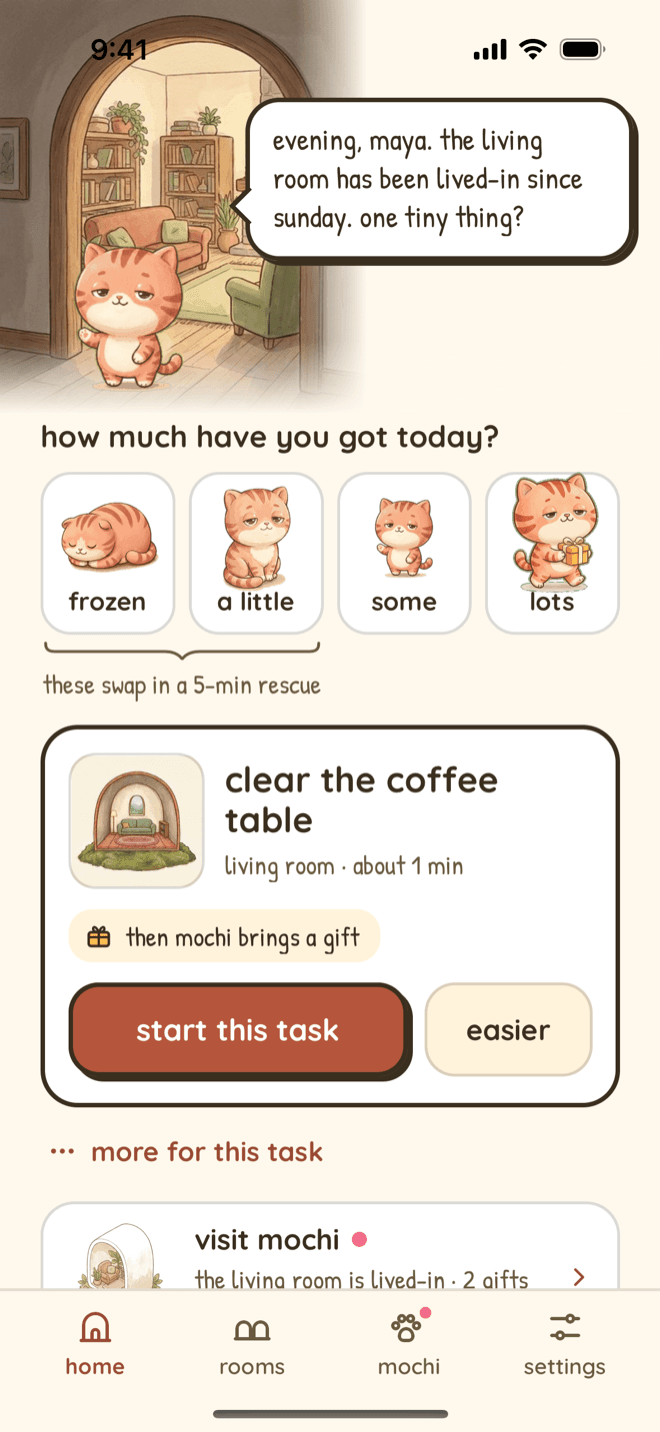
one thing, about a minute
Sized to the window you actually have, not the room you wish you could do.
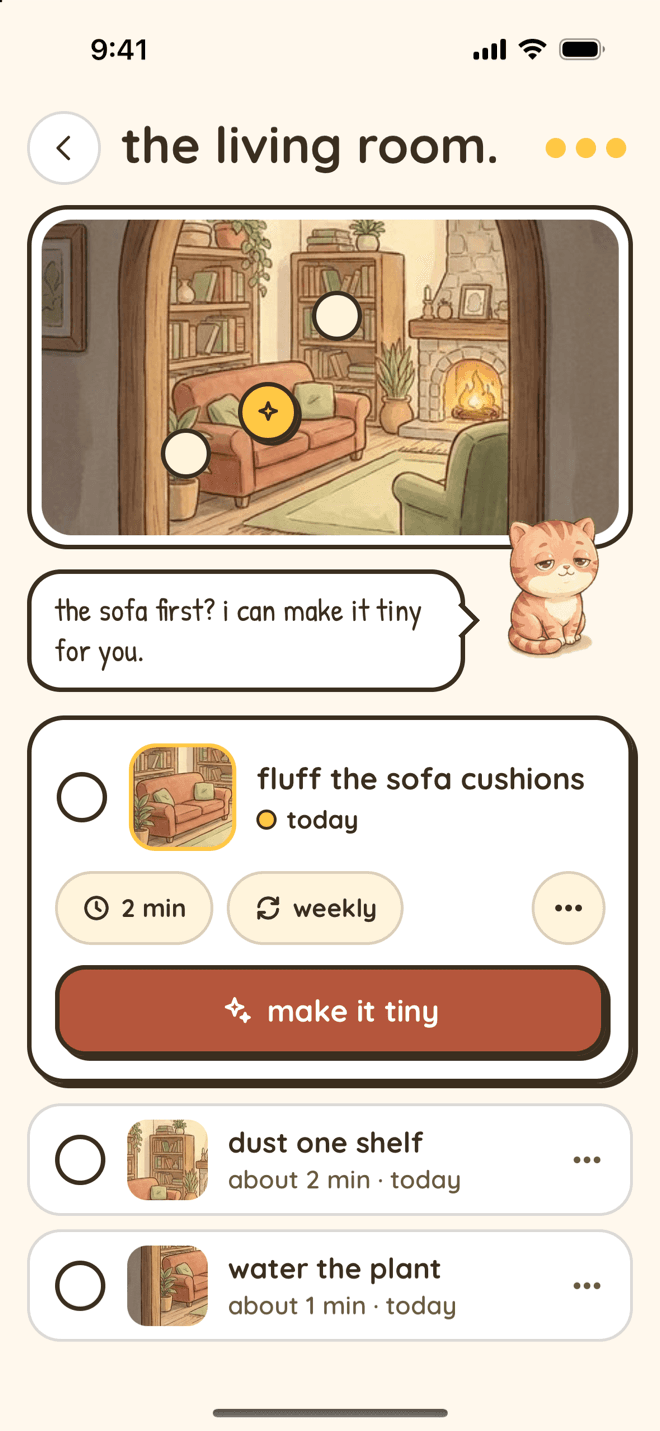
a room, in minutes
Each task on the room's page says how long it takes, and Mochi offers to make the first one tiny.
Sizing the task to the window
You tell Nudge roughly how long you have and how much you have in you, and it gives you one task that fits — clear one small surface, put four things away, deal with the cups. One thing, finished, rather than a room started and abandoned.
Panic Clean exists for the version of this where someone is about to arrive and the clock is the only thing that matters. Voice guidance keeps going with the phone in a pocket, which is the only way any of this works one-handed.
And the thing that is deliberately missing: no points and no leaderboard. The one streak counts days you finished something, forgives a missed day each week, and cannot go down because a two-year-old emptied a drawer.
One thing, in the time you actually have
Nudge is a subscription for iPhone, billed only through the App Store. Weekly is $2.99 with no trial. Monthly is $6.99 and Annual is $49.99, and both include a 7-day free trial for eligible new subscribers.
Related
If your week does not repeat either, the shift-work version of this page covers why weekly schedules break. For guests arriving imminently, panic cleaning before guests is the version you can act on without installing anything.
Other situations: ADHD cleaning app for students, ADHD cleaning app for shift workers, ADHD cleaning app for late-diagnosed adults.
Questions
Can it give me something I can finish in four minutes?
Yes. You tell it how long you have — five, ten or twenty minutes — and the task is sized to that. If four minutes is what there is, a five-minute task you finish is worth more than a twenty-minute one you abandon.
The room gets undone every day. Does the app hold that against me?
No. What Nudge counts is the days you finished something, never the state of the room, so a room coming undone does not touch it. Its streak forgives a missed day each week, there are no points and no leaderboard, and finished tasks fill in Mochi's Place, a companion cat's island of rooms that only grows. What you earned stays earned.
What about the days nothing happens at all?
One missed day a week is covered by the streak, and nothing turns red. After a longer gap the streak starts again from one, and Mochi may mention that a room has looked lived-in since a certain day. No plan is sitting half-finished when you next open it, and the rooms you filled in stay filled in.
Can I use it with a child in the room?
Sessions are voice-guided and keep going with the phone in a pocket, so a step can be followed without looking at a screen. Start Rescue reads a single physical step aloud, which also survives being interrupted halfway.
Does it handle shared chores with a partner?
Not really, and that is a real limitation. Nudge is a single-user app with no shared household and no chore rota. You can ask your partner to take one task by sending a Mochi postcard, and their answer shows on your Home, but that is one task at a time, not a shared plan. If splitting chores with someone else is the main thing you need, the comparison hub names apps that do it.
Is Nudge free?
No. It is a subscription for iPhone. You can try one tiny task before you choose a plan. Weekly is $2.99 with no trial. Monthly is $6.99 and Annual is $49.99, and both include a 7-day free trial for eligible new subscribers.
How we checked, and when
Nudge's own plan details was read on 2026-09-15 from the company's own website or its current App Store listing. What Nudge counts, what a gap does, and what a Mochi postcard can do were checked against Nudge 1.3.5 on 2026-10-13. Apps change their prices, their billing providers and their cancellation flows. Confirm anything that matters to you before you subscribe or cancel, and tell us if something here is out of date: support.
Nudge organizes cleaning tasks; it does not diagnose or treat ADHD.